Anthropic’s New Labour Market Study Reveals a Hidden Gap
Mar 06, 2026
The AI Productivity Gap: What New Labour Market Research Means for Organisations
Anthropic, the company behind Claude AI, recently in the news for taking a cautious approach to how its technology can be used in military settings, has analysed millions of AI interactions across approximately 800 US occupations to understand how artificial intelligence is affecting everyday work.
We have been through the report and set out our view here.
Are there surprises? Not really, but it without question reinforces the opportunity that individuals and business believe they have available to them but are struggling to reach.
They released their research paper titled "Labor market impacts of AI: A new measure and early evidence" on 5th March 2026, it looks at how artificial intelligence is affecting the labour market.
What the Anthropic Research Shows
The study analysed millions of real uses of AI tools to understand which types of work are being supported by AI and where the largest opportunities exist.
Across many professional roles the data shows that AI is capable of helping with a large share of everyday work. Yet the amount of AI actually used inside organisations today remains much lower. In many cases the technology could support 70% to 90% of certain tasks, while real usage today is closer to 20% to 30%.
This gap between capability and real use creates one of the largest productivity opportunities currently available to business.
Understanding where this gap exists and how to close it shows which teams gain the most value from AI in the years ahead.
Where AI Is Already Affecting Work
The research identified jobs where AI is already helping with daily tasks and activities. The study calls this AI exposure, meaning the share of tasks in a role where AI can help.
The occupations with the highest levels include:
-
Computer programmers
-
Customer service representatives
-
Data entry specialists
-
Medical record specialists
-
Market research and marketing specialists
-
Sales representatives
-
Financial analysts
These roles all have something in common. They involve working with information, analysing data, writing documents or working with digital systems.
AI tools work well when tasks involve text, documents, structured information or analysis. This is why knowledge based roles show the highest level of AI use.
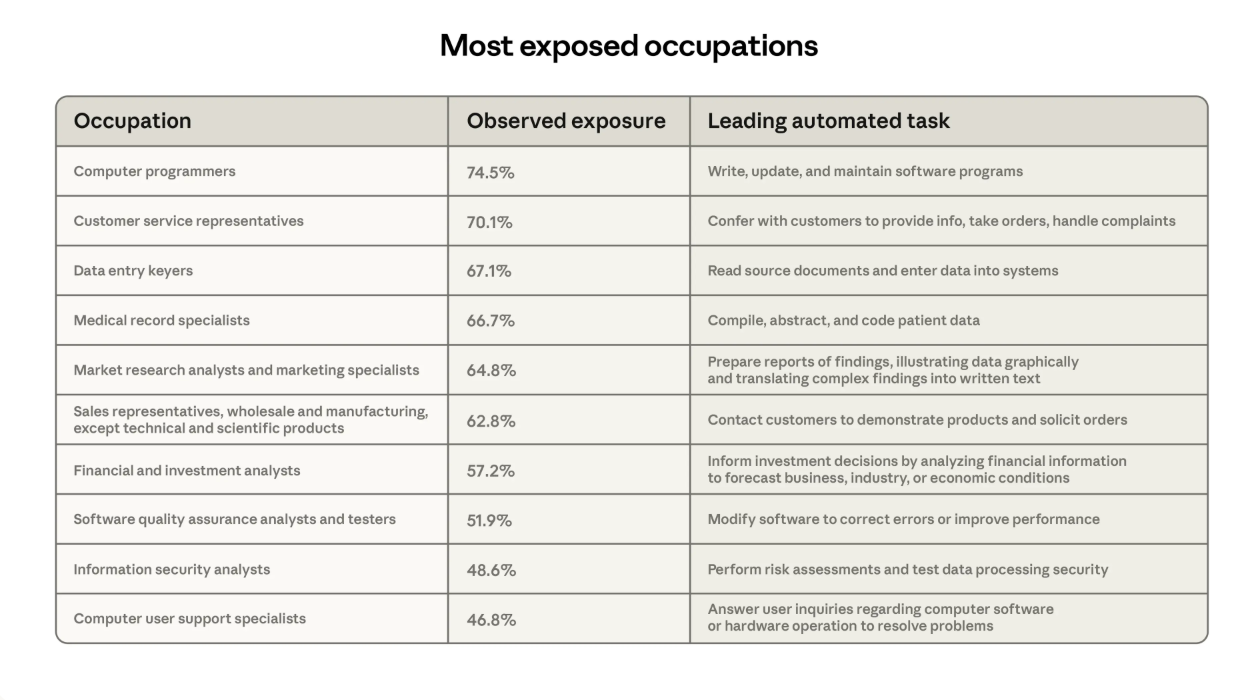
Jobs with the highest AI use tend to involve writing, analysis, and working with digital information.
Source: Anthropic - Labor Market Impacts of Generative AI (2026).
Where AI Can Support Internal Business Functions
Even though the research lists out specific job roles, the same types of tasks appear across most internal departments in organisations.
In typical businesses, teams such as procurement, marketing, project management, operations, finance, sales and strategy all carry out work that involves analysing information, preparing documents, producing reports and sharing information with colleagues or customers.
These are exactly the kinds of tasks where AI tools work well. Examples include:
- Procurement: Comparing supplier proposals, drafting RFQs, summarising long contracts, checking pricing differences between vendors, preparing supplier comparison tables.
- Marketing: Reviewing campaign performance data, drafting and editing marketing content, analysing competitors, summarising customer feedback, preparing campaign reports.
- Project Management: Identifying potential project risks, tracking open actions across teams, preparing project updates for leadership, summarising meeting notes into clear next steps.
- Operations: Documenting how processes actually work, preparing internal operational reports, organising large amounts of workflow information into clear procedures.
- Finance: Summarising financial analysis, preparing monthly management reports, explaining changes in revenue or costs, checking inconsistencies in financial data.
- Sales: Researching customer accounts before meetings, drafting proposals, preparing follow-up emails, summarising meeting notes and turning them into actions.
- Strategy & Leadership: Preparing leadership briefings, summarising large research reports, consolidating information from different teams, drafting decision papers for executives.
These examples show that the tasks where AI works best which are common across most departments. This means the opportunity for productivity improvement is not limited to technical teams but to roles that you reading this most likely have.
AI Is Most Relevant for Knowledge Workers
Another important finding from the research relates to the types of workers whose roles are most affected by AI.
Workers in roles where AI can help the most often have:
-
Higher levels of education
-
Higher average wages
-
Jobs that involve analysis, writing, and information management
For example, workers with a bachelor's degree make up a much larger share of roles where AI can help compared with workers without higher education. Graduate degree holders also appear more often in these roles. The data also shows that workers in these roles earn higher hourly wages on average.
This tells us something important about how AI is and is not changing work.
AI is shown to be most useful in jobs that involve thinking, analysing information, writing and helping prepare decisions, this is no surprise.
These are the same kinds of activities carried out in departments such as finance, marketing, procurement, operations and sales.
Because these roles depend heavily on information, AI tools can often reduce the time needed to complete many tasks. This can lead to several benefits for employees and businesses:
-
Tasks completed faster
-
Clearer written documents
-
Better preparation for meetings and decisions
-
More time available for higher value work such as solving problems or working with customers
The research also shows that the average age of workers in roles where AI can help is slightly higher than in roles where AI has little use. The difference is small, but it suggests that many people using AI tools today are mid‑career professionals.
This is important because AI tends to be most useful when it is combined with experience and understanding of how organisations work. Employees who have spent years in a role usually understand how different teams operate and what information is needed to move work forward.
When these experienced professionals use AI, they can review information faster, organise ideas more clearly and prepare better inputs for other teams.
For example, people working in roles such as sales, finance, procurement or project management often work with several departments. AI can help them summarise information, prepare documents and organise context before passing work to colleagues in other teams. This can improve the speed and quality of collaboration between departments.
In practice, AI should be seen as a tool that helps experienced professionals work more effectively, rather than something that replaces those roles.
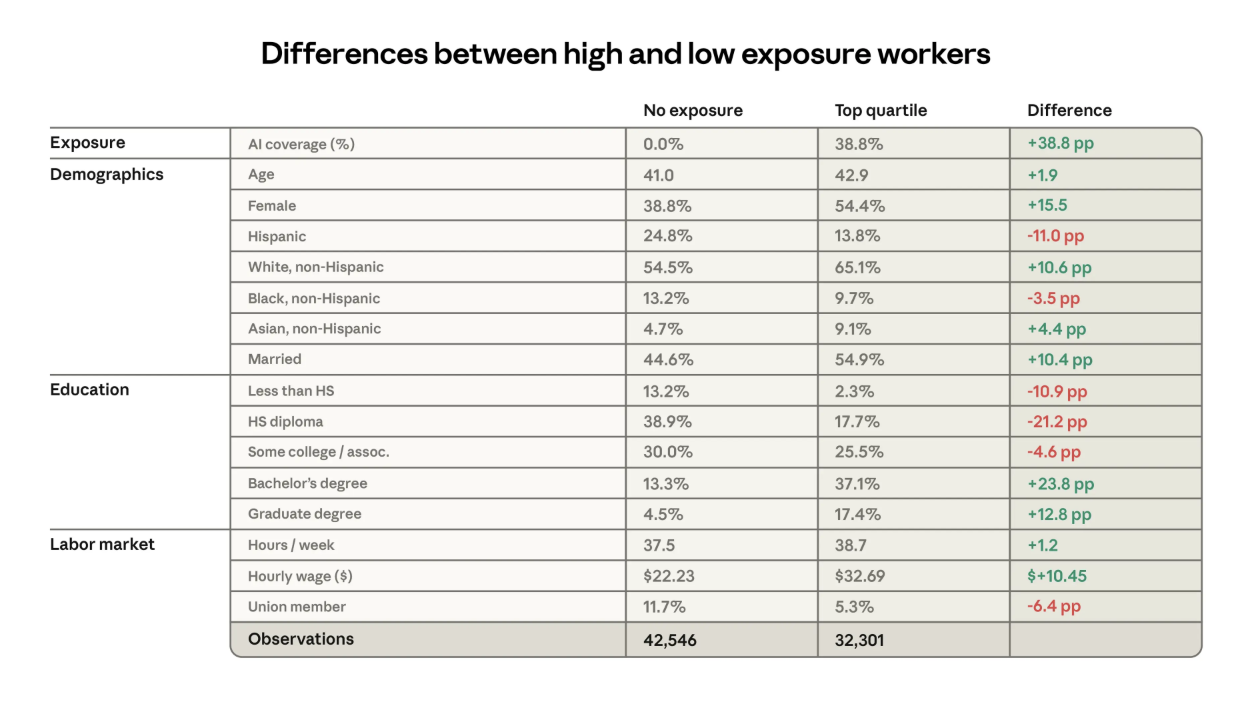
Workers with higher education levels and higher average wages appear more often in jobs where AI can help.
Source: Anthropic - Labor Market Impacts of Generative AI (2026).
AI Does Not Currently Increase Unemployment
A common concern about artificial intelligence is that it could lead to large job losses. The research looked at this question by comparing unemployment trends for workers in roles where AI can help and workers in roles where AI has little use.
The analysis reviewed unemployment data from 2016 to 2025. The result is clear. There is no measurable difference in unemployment trends between workers in roles where AI can help and workers in roles where it does not. Even after the release of ChatGPT in late 2022, unemployment patterns for these groups remain very similar.
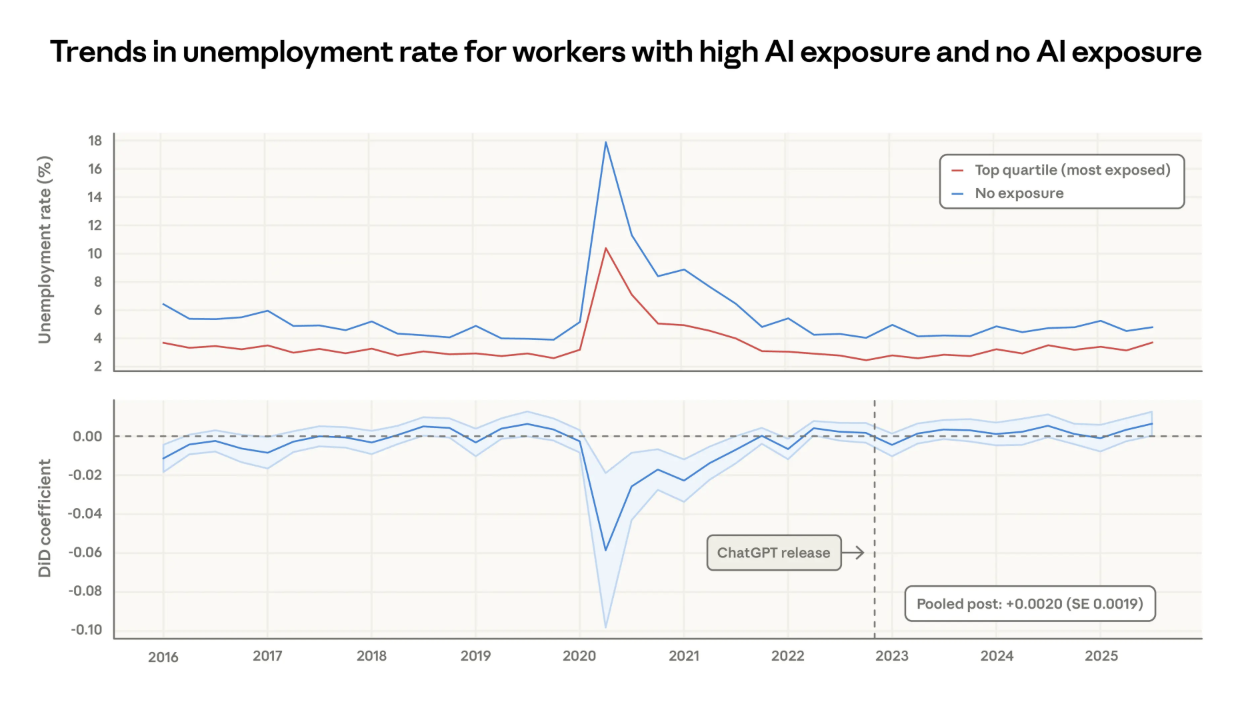
Unemployment trends for workers in roles where AI can help are very similar to those in roles with little AI use.
Source: Anthropic - Labor Market Impacts of Generative AI (2026).
This suggests something important. AI is currently working mainly as a tool that helps people do their jobs better, rather than removing jobs entirely. For many professionals, AI can help with tasks such as drafting documents, reviewing information, preparing summaries and organising complex data.
When these tasks take less time, employees can:
-
produce better outputs
-
complete work more quickly
-
manage larger workloads
-
spend more time on strategic or creative work
For organisations, this usually means higher productivity from existing teams, rather than fewer employees.
The Most Important Insight: The AI Adoption Gap
While the research shows where AI can help with work, another insight is even more important.
There is a large gap between what AI can do and how much it is actually used today.
This gap appears across many professional roles including management, administration, marketing, finance, and legal work.
For knowledge workers, this creates a major opportunity. If even part of this unused potential were applied across everyday work, organisations could see improvements in:
-
time efficiency
-
quality of outputs
-
speed of analysis and reporting
-
overall team productivity
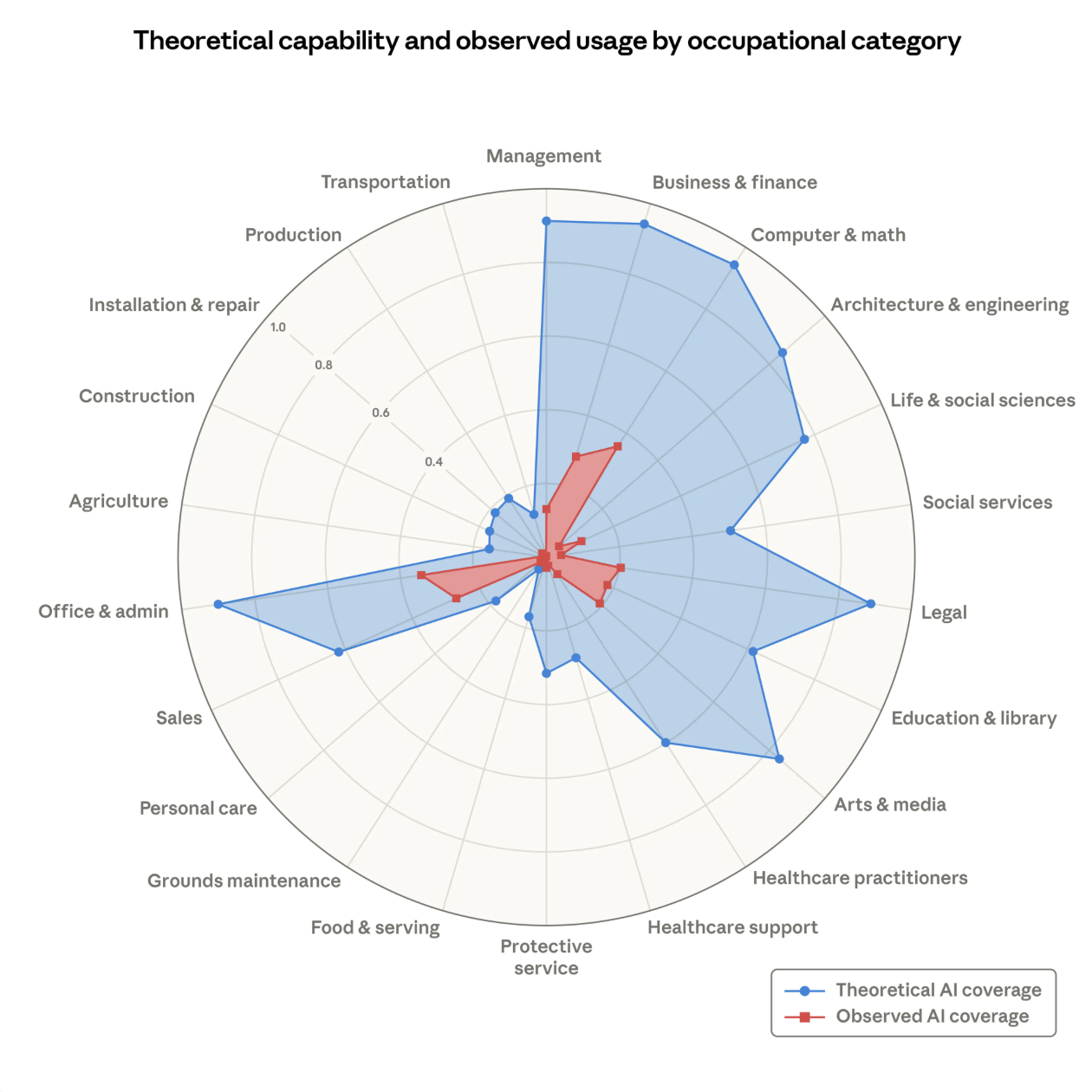
The potential share of tasks where AI could help is much higher than the level of AI currently used in organisations.
Source: Anthropic - Labor Market Impacts of Generative AI (2026).
Why This Gap Exists
Most organisations already have access to AI tools such as ChatGPT, Microsoft Copilot, and other AI assistants.
However, simply giving teams access to these tools does not automatically improve productivity. The main challenge organisations face is understanding how AI fits into the actual tasks employees carry out every day.
Common barriers include:
-
employees trying AI occasionally but not using it daily
-
teams using AI differently across departments
-
organisations introducing AI tools without training
-
lack of clear guidance on when and how to use AI during a task
These issues explain why many organisations see small experiments with AI rather than widespread productivity improvement.
Turning AI Capability Into Productivity
Research across the industry shows that structured adoption programmes can produce measurable productivity improvements.
Our interpretation of studies from organisations such as Microsoft, MIT, and Stanford show productivity gains between 20% and 40% when employees use AI tools in tasks such as writing, analysis, coding, and research. These gains usually appear when organisations focus on specific tasks, rather than introducing AI as a general tool.
A structured approach normally includes three steps.
1. Identify high‑impact tasks
Find the activities that consume the most time across teams.
2. Redesign workflows
Introduce AI into parts of these tasks where it can speed up analysis, writing, or information processing.
3. Train employees
Ensure teams understand how to perform these new processes consistently.
When organisations follow this approach, the gap between AI capability and real use begins to close and productivity improvements become measurable.
The Opportunity For You
The research confirms that artificial intelligence can already help with a large share of professional work. At the same time, most organisations are only beginning to explore how these tools can be used in everyday operations.
The difference between what AI can do and what organisations currently do with it creates one of the largest productivity opportunities available to businesses today. Organisations that focus on practical adoption, task‑level integration, and workforce training are likely to gain the greatest benefit from this change in how work is performed.
Source of research: Anthropic. "Labor Market Impacts of Generative AI" (2026).
Closing Perspective
The research from Anthropic shows that the opportunity with AI is not theoretical.
The technology already has the capability to support a large share of the work carried out by knowledge workers every day. The real challenge for organisations is not access to AI tools.
Many teams already have them. The challenge is learning how to use them properly within the tasks and workflows that people perform in their roles.
When individuals understand how to apply AI to the work they already do, the results are clear: time saved, higher quality outputs, and more capacity to focus on the parts of work that require human judgement and experience.
For organisations that invest in building these skills across their teams, the productivity gains can appear quickly once people know how to use the tools effectively. For organisations looking to close this gap, the starting point is simple: help teams understand how AI can support the tasks they already perform every day.
Discuss Practical AI Training for Your Team